
The RedBook Insider: ADAS Fitment is Surging - But the Risk Pool Is Still Stuck in the Past
Autonomous vehicles may dominate the headlines, but the real precursor to autonomy is already here: the widespread fitment of foundational Advanced Driver Assist Systems (ADAS) technologies. Features such as Autonomous Emergency Braking (AEB), Lane Keep Assist (LKA) and Intelligent Speed Assistance (ISA) are the building blocks of automated driving, yet Australia’s vehicle parc remains years away from having these systems fitted consistently across the road fleet. The challenge is not just when fully autonomous vehicles arrive, but how quickly today’s proven safety technology becomes standard in the vehicles Australians actually drive.
That transition is already well underway in the new-vehicle market. ADAS, including combined AEB car-to-car, LKA and ISA advisory, have moved from premium niche to mainstream standard. RedBook data shows “Definitely Standard” fitment across new car sales has surged to 66.5% in Q1 2026, up from under 10% in 2020, while “Not Available” has collapsed from over 60% to just 10.7%. A further 13.9% are “Possibly Standard” and 8.9% “Possibly Optional”.
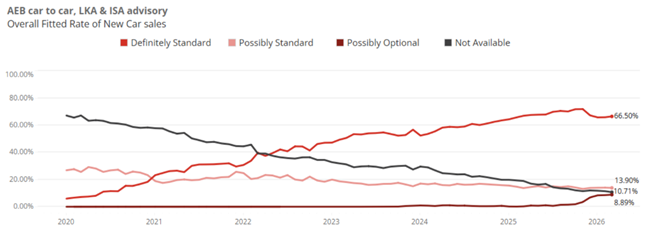
ADAS fitment is classified using RedBook specification data into “Definitely Standard” where a feature is confirmed across all variants or “Possibly Standard” where fitment is inferred but not consistently verified at a variant level. This distinction reflects real‑world uncertainty in manufacturer sales and ensures the analysis separates confirmed baseline safety equipment from cases where availability may vary by trim, pack, or update cycle.
The volume leaders are doing the heavy lifting, with Ford Ranger, Mitsubishi Outlander, Hyundai Kona, Isuzu D-MAX and Mitsubishi Triton all now Definitely Standard, putting safety tech into the hands of mainstream Australia. The laggards, with some surprising inclusions given their relative “newness”, are the Mazda CX-3, Suzuki Jimny, Kia Picanto and outgoing Mitsubishi Pajero Sport.
Where the ADAS Gap Is Emerging
The weaker fitment ratios are not evenly spread across the market. Several high-volume or commercially important segments are emerging as clear points of divergence, creating implications for residual values, underwriting assumptions and future used-vehicle demand.
- SUV Light
- Light Commercial PU/CC 4x4
- SUV Small >$45K
- SUV Large <$80K
- Passenger Micro
ADAS becomes the expected baseline, vehicles in these segments risk being assessed differently by insurers, financiers, dealers and wholesale buyers. In practical terms, the safety gap is becoming a commercial gap.
That commercial gap will be felt differently across the market. For insurers, ADAS-equipped variants create a stronger case for more granular pricing: the technology may support claims-frequency repricing, but it is not a one-way benefit, with sensors, cameras and calibration requirements also introducing higher repair costs and greater claims complexity. For financiers and lessors, ADAS fitment is becoming a residual value signal, with buyers and wholesale channels likely to favour safer specifications.
And the parc tells the real story: BITRE puts the average Australian passenger car at 11.1 years and equivalent Light Commercials at 11.4 years, meaning most vehicles on our roads pre-date today's ADAS baseline. The TAC's howsafeisyourcar.com.au remains an essential consumer compass, but for our industry, the commercial signal is clear: the market needs to recognise and price the safety difference between ADAS-equipped vehicles and those still operating without today’s expected safety baseline. If these features were more consistently fitted across the national vehicle parc, the evidence suggests they could help prevent or mitigate a meaningful share of everyday vehicle-to-vehicle incidents, particularly rear-end, lane-departure, run-off-road and head-on crashes.
Recent Posts
-
 The RedBook Insider: The Ownership Stress Test Is Yet to Come21st September 2026
 -
 The RedBook Insider: Australia's EV Moment Arrived Quietly. August Proved It.21st September 2026
 -
 The RedBook Insider: The Return of Badge Engineering: Can a Familiar Logo Sell Unfamiliar Tech?21st September 2026